
August 2026 Edition: Where Stories Meet Movement
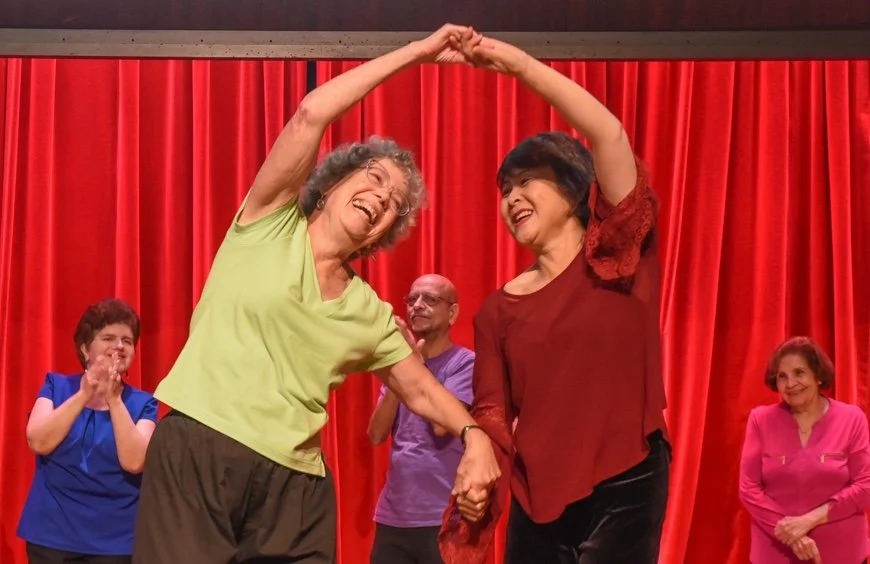
Photo by Ben Ouriel (2025), courtesy of NYU Steinhardt
Dear friend,
For as long as I can remember, I have felt a deep-seated drive to connect, to understand others: what moved them, what they saw, and what they felt about the world we share. As much as I devoured books, I often struggled to find spoken language that could bridge the chasms between myself and others. It was through dance that I discovered a tool that helped me listen, communicate, and understand others, and, eventually, myself.
That desire for connection has continued to shape my work and, ultimately, the work of DanceStream Projects. I am drawn to creating spaces where people can see and be seen, hear and be heard, and discover new ways of expressing what words sometimes cannot.
This month, I have been thinking a lot about just how deeply connected spoken language and movement really are.
As we begin our Raising Our Voices project across three boroughs and five communities with people living with dementia and older adults, I have been struck by the generosity and openness with which each community has embraced this new proposition. Together with our dance teaching artists and resident poet Mark Timmons, participants are exploring what happens when poetry, movement, memory, and imagination meet.
And what is emerging is extraordinary.
The poems being created and the dances taking shape span a remarkable spectrum of feeling and experience—from the humorous and unexpected to the deeply moving. There is a kind of conversation happening in these rooms that does not depend on everyone speaking in the same way—or even speaking at all.
I have always felt there is a profound connection between language and movement, speech and dance. What is exciting is that research is increasingly helping us understand that this connection is more than metaphor.
In this issue, read about new work by our colleagues and collaborators Dr. Constantina Theofanopoulou and Dr. Aline Haas, whose research explores the relationships between dance, movement, speech, and neurodegenerative disease. Their work invites us to think differently about communication—not as something that happens only through words, but as something deeply embodied, rhythmic, relational, and connected to the ways we move through the world.
This feels particularly meaningful to me because it reflects something we experience every week in our programs: our practice of expression through movement is helping even those who struggle to access words discover a new language of connection.
And that brings me back to community.
This summer, our community has continued to grow. In partnership with the NYU Langone Alzheimer's Disease Research Center, we brought Brain Health Dance Socials to Sunset Park Older Adult Center and Sunnyside Community Services—two predominantly Spanish-speaking communities where we had the joy of meeting new participants, sharing movement, and discovering new possibilities for connection.
Across all of these spaces, I am reminded that there is no single language of connection.
There are words. There is poetry. There is dance. There is music. There is laughter. There is the simple yet powerful act of moving alongside another person.
At DanceStream Projects, we are interested in all of them.
When we create more ways for people to express themselves, we create more ways for people to be seen. And when we create more ways to listen, we create more possibilities for understanding.
Thank you for moving with us!
With gratitude,
