
Where Movement Meets Language: New Research on Dance, Parkinson’s Disease & Speech
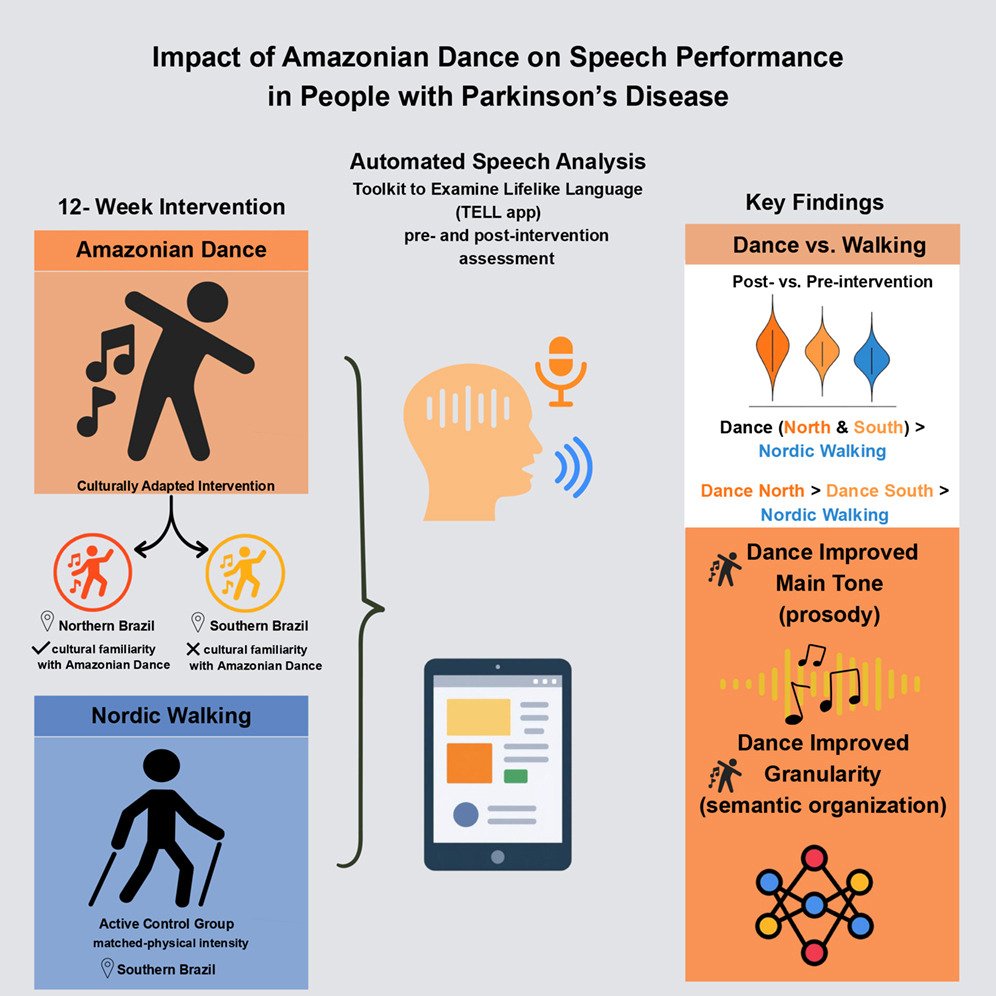
Source: Prates RA et al. Impact of Amazonian dance on speech performance in people with Parkinson's disease. iScience. 2026 Aug 10;29(8):117185.
What if the benefits of dance extend beyond how we move our bodies—and into how we use our voices?
New research co-coordinated by Dr. Constantina Theofanopoulou and Dr. Aline Nogueira Haas, and led by Raquel Arigony C. S. Prates and colleagues, offers exciting new evidence exploring this question in people living with Parkinson’s disease.
Dance-based interventions have repeatedly been associated with improvements in gait, balance, and motor function in Parkinson’s disease. Building on this body of work, the research team led innovative research investigating whether dance might also influence the motor systems involved in speech and vocal expression.
In a 12-week randomized trial, participants with Parkinson’s disease took part in either an Amazonian Dance program or a matched-intensity Nordic Walking program. Before and after the intervention, researchers used the Toolkit to Examine Lifelike Language (TELL), an automated speech and language analysis platform, to objectively assess changes in participants’ speech and language.
The results were striking: participants in the dance groups showed significant improvements in prosody (pitch control), voice quality, and semantic organization, while the walking group showed declines in these measures. The researchers also explored the role of cultural familiarity with Amazonian dance, finding the strongest improvements among participants in Northern Brazil, where these dance traditions are more culturally familiar.
These findings add an exciting new dimension to our understanding of the relationship between movement and communication. They suggest that dance may influence not only how people with Parkinson’s move, but also aspects of how they speak, organize language, and express meaning.
For us at DanceStream Projects, this work resonates deeply with a question we return to again and again: What happens when we expand our understanding of communication beyond words? Dance may offer one pathway into that larger conversation—connecting movement, voice, rhythm, cognition, culture, and human expression.
We are especially delighted to celebrate this work because both Dr. Theofanopoulou and Dr. Haas have been guests on our Dancing into Brain Health podcast, where they shared their perspectives on the connections between dance, neuroscience, communication, and brain health.
Read the new research: Read the article →
This study adds to an emerging body of research and does not establish that dance is a treatment for speech or language difficulties in Parkinson’s disease. Rather, it offers promising evidence for further investigation into how dance may affect multiple systems involved in movement and communication.
Curious to learn more?
Hear Dr. Constantina Theofanopoulou: Dancing into Communication — Listen to the episode →
Hear Dr. Aline Haas: Amazonian Dance for Parkinson’s — Listen to the episode →
This article was featured in the August 2026 Dancing into Brain Health Newsletter.