
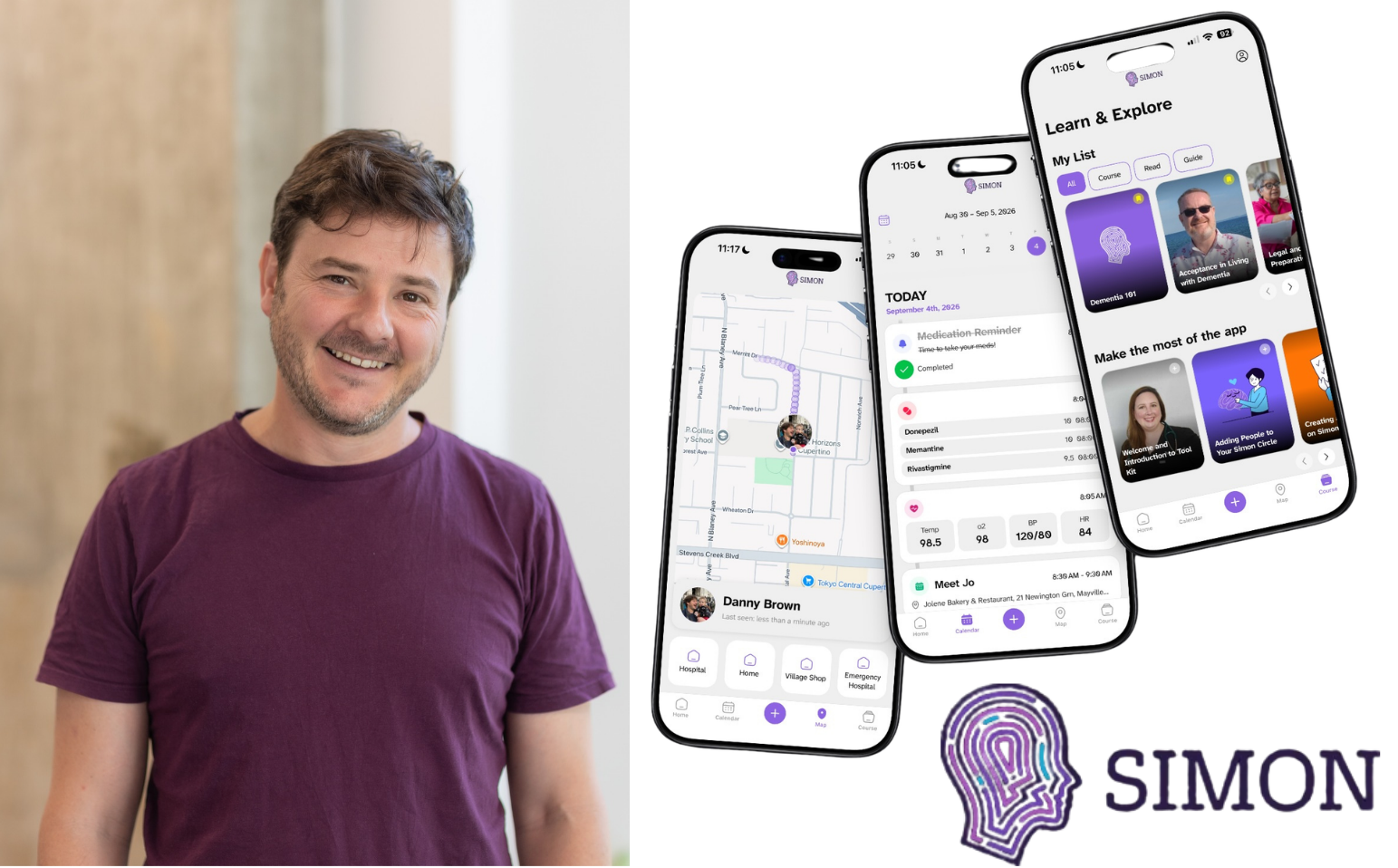
What happens when technology, lived experience, science, and the arts come together to imagine a different future for dementia care?
For DanceStream Projects, we believe brain health is not only about what happens in a clinic. It is also about connection, creativity, movement, communication, autonomy, and the relationships that help us remain engaged in the world around us.
That is why we were excited to sit down with Daniel Brown, CEO and founder of Simon Care, for a conversation about the changing landscape of dementia care—and the possibilities that emerge when digital innovation meets community-based, creative approaches.
Daniel’s own path into dementia care began personally. After supporting his mother-in-law through an Alzheimer’s diagnosis, he began thinking differently about what it means to understand and support cognitive change. His background and interests in language acquisition and social cognition led him to explore how technology might help us better understand the everyday experiences of people living with dementia.
One insight was particularly powerful: our everyday behaviors can tell us a great deal about how we are doing.
Smartphones and other digital tools, for example, have the potential to help track patterns in daily habits that may be connected to changes in executive function. But for Daniel, technology is not an end in itself. It is a tool for creating greater understanding, autonomy, and connection.
From technology to education and community
Simon Care has evolved considerably since its beginnings.
As Daniel and his team listened to users, they discovered something fundamental: people needed much more than another digital tool. They needed knowledge.
Families and individuals navigating dementia frequently find themselves trying to understand a diagnosis, medications, care options, communication challenges, and what comes next—often with surprisingly little guidance.
In response, Simon Care expanded its focus on education, bringing healthcare professionals and people living with dementia into the platform as teachers and knowledge-sharers.
Today, people engage with Simon Care through educational lessons, newsletters, and tools designed to support medication coordination and everyday life.
But the larger ambition is even more expansive: to help people living with dementia maintain autonomy outside the home and build stronger relationships within their communities.
That vision resonates deeply with DanceStream’s approach.
Rethinking what dementia care can look like
Our conversation also touched on some of the larger challenges within dementia care infrastructure.
Too many people still experience long waits, gaps in diagnosis, and limited access to meaningful support. And while healthcare systems play an essential role, families and unpaid care partners continue to carry an enormous share of the day-to-day work of dementia care.
Daniel spoke about the importance of thinking about dementia not only through the lens of disease, but also through the lens of disability, accessibility, and participation.
That shift matters.
When we ask, “How can we help someone continue to participate?” rather than simply “How do we manage the disease?”, a much broader range of possibilities opens up.
Technology becomes one possibility.
Community becomes another.
And so do dance, music, poetry, storytelling, and other forms of creative expression.
Where movement meets technology
During our conversation, we began imagining what it might look like to bring these worlds together.
At DanceStream, our programs use movement as a way to support communication, connection, confidence, and participation. In Stories in the Moment, for example, signature movement prompts can become familiar anchors that help participants transition into and through activities.
These approaches are deeply embodied. They are also relational: the movement happens with other people.
So what might happen if digital tools could extend that experience beyond the studio or community center?
We discussed possibilities ranging from asynchronous movement and creative content to opportunities for synchronous interaction—creating digital experiences that are not simply something a person watches, but something they can participate in.
The goal isn't to turn dance into a digital therapy.
Instead, it is to explore how movement and the expressive arts can be understood as tools for brain health, wellbeing, communication, and social connection—and how technology might help make those opportunities more accessible.
For both Simon Care and DanceStream, innovation must be grounded in evidence and shaped by the real-world experiences of people living with dementia and their care partners. Simon Care is actively exploring partnerships with health systems and research institutions as well as opportunities to work with anonymized data to better understand how digital and community-based interventions can impact people’s lives.
What is especially inspiring about Simon Care’s approach is that innovation is guided by a fundamental question: How can we build new models of dementia care that are not only imaginative, but also measurable, accessible, and responsive to what people actually need?
Imagining what comes next
Our conversation with Daniel left us energized by the possibilities ahead.
There is an enormous opportunity to build bridges between sectors that don't always work together: technology and the arts, researchers and community organizations, healthcare systems and people living with dementia, digital experiences and embodied experiences.
And perhaps most importantly, there is an opportunity to move beyond thinking about people living with dementia solely as recipients of care.
They can be teachers, creators, collaborators, community members, innovators, and partners in designing what comes next.
At DanceStream Projects, we are excited to continue exploring these possibilities with Simon Care—from developing prototype creative content and pilot experiences to exploring future research and funding partnerships.
Because the future of dementia care will not be created by one discipline alone.
It will take many perspectives, many kinds of knowledge, and many ways of connecting.
And sometimes, it may begin simply with an invitation to move, create, listen, and imagine together.
Connect with Simon Care
Interested in learning more about Simon Care or exploring opportunities to collaborate?
Visit Simon Care or connect with Daniel Brown on LinkedIn.
This conversation was part of DanceStream Projects' ongoing conversations with innovators, researchers, artists, advocates, and people living with dementia about the future of brain health and dementia care.