
Dancing into Brain Health - Special Issue: Mental Health Awareness Month
More Good Days, Together: A Conversation on Mental Health, Brain Health and Community
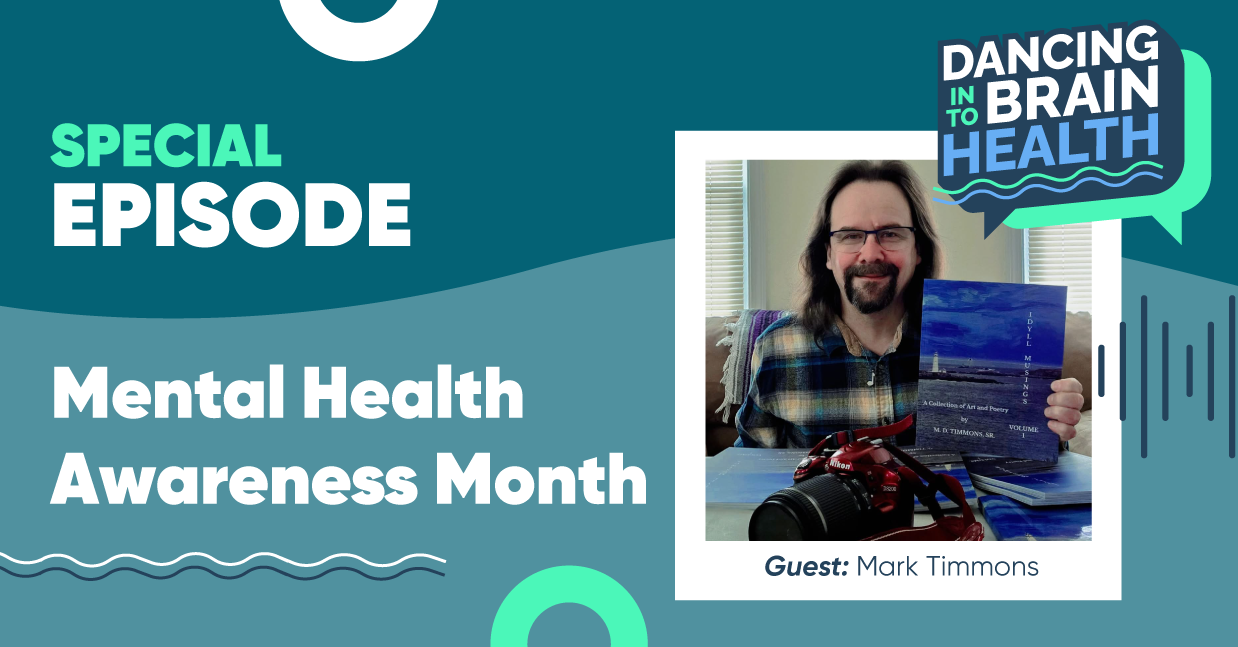
In honor of Mental Health Awareness Month 2026, DanceStream Projects executive director Magda Kaczmarska sat down with Mark Timmons, artist, advocate and person living with dementia, for a conversation about the intersections of mental health and brain health.
Content Note:
This conversation includes personal experiences related to mental health, including discussion of suicide loss and eating disorders. We recognize that these topics may feel sensitive or activating for some listeners and readers. We invite you to engage with this conversation in whatever way feels most supportive for you, whether that means taking breaks, listening with support, or choosing to return to it at another time. Our hope is that this conversation offers compassion, connection, and a reminder that no one has to navigate these experiences alone.
Listen here
Transcript
Magda Kaczmarska:Hello, hello. I'm Magda Kaczmarska. I'm the executive director of DanceStream Projects. And I am joined today by my dear friend, colleague and collaborator, Mark Timmons. Today is May 11th and we are celebrating and commemorating a very important month. May is Mental Health Awareness Month.
I'm joined here today by Mark Timmons to have a conversation about this. Mark, what does mental health mean to you and why does it matter?
Mark Timmons:Well, thank you for having me on, Magda. And I guess I should start by explaining that to me, mental health isn't just about whether someone has a mental illness. Everybody has mental health, just like everyone has physical health. I think mental health refers to our emotional, our psychological, and our social well-being.
And it's important because I mean, I think that mental health has more of an impact in everyday life than our physical and neurological health. Because even when we face challenges like brain health challenges and dementia or other chronic conditions, it's our mental health that helps us face those challenges and helps us shape how we're going to react to those challenges to other types of our health.
So good mental health helps you cope with stress. It helps you stay productive and make clear decisions. It affects how you communicate, how you trust, how you connect with others. Mental and physical health are closely linked. So poor mental health can increase the risk of physical problems.
Basically mental health is the backbone to resilience and well-being. Strong mental health helps you recover from challenges and setbacks and trauma. In short, mental health matters because it shapes how you experience life and deals with the ups and downs that come your way.
Now for me, personally, for someone living with dementia, mental health shapes how we experience the condition, not just what we remember, but how we feel and connect and live each day. Because with dementia, with brain change, with memory changes, emotional experiences remain strong even when you forget the details. You remember how something feels and that ties in with mental health. And so supporting mental health means having more moments of well-being, more moments of comfort and autonomy and joy and meaning, you know, while living with brain conditions.
I guess finally, you know, on a personal level, mental health means more to me having stood by, feeling helpless at times as I watched my son, who was an intellectually gifted child as well as a music prodigy as a child, eventually succumb to his own battle with mental illness at the age of 26. His death opened my eyes to the need for more advocacy.
As an advocate in the dementia community, I speak a lot about changing what we call the tragedy narrative. And I feel now that I understand that a tragedy narrative also exists within the world of mental health and mental illness. And this needs to change. Just in the United States, someone dies by suicide every 11 minutes. To think about it another way, you're sitting on your couch watching your favorite TV show. Every time it goes to a commercial break somebody's taken their own life in this country.
Mental health just needs more advocacy and more empathy.
Magda Kaczmarska:Every single time that we have a chance to speak, Mark, I'm humbled, honored, and in awe of the life that you have walked and how you have chosen to lean into all of the things that you have navigated and are navigating. And transmuted them into a platform that unites people, that raises awareness and encourages us to come together and find common action. So I thank you for joining me today in this conversation and hopefully others who are listening will be as inspired as I am every time we connect.
Something I wanted to reflect back on what you said was that sense that, particularly for somebody who's living with brain change, that emotional connection is something that is even more important, that is almost like a tether. And I think often of the quote that has been at times attributed to Maya Angelou, that we may not remember what somebody said or what they did, but we will always remember how they made us feel.
I wonder for you, what are some of the ways that you take care of your mental health?
Mark Timmons:Well, you know, to support my brain health and my mental health, I find that engaging in the arts is vital. I write. I try to immerse myself in nature when possible and practical. To shoot photography. I enjoy music and collaboration on projects related to music and poetry and dance and movement.
Combining all of these helps me maintain and at times improve my mental health as well as my brain health. I find that the arts serve as an outlet for feelings. What I mean by that is that poetry helps to put words in rhythm to my emotions. Dance and movement give my words a visual expression as well as a physical outlet. For me, living well with dementia is truly supported by my love of the arts.
But it's also important to fully support mental health as well as getting enough exercise and proper nutrition as any type of health is supported by nutrition and exercise.
Magda Kaczmarska:You are obviously a poet. I love that idea of poetry putting emotions into a rhythm. You and our organization, DanceStream Projects, have been collaborating on the synergy and kind of synchronicity between dance and poetry, movement and language. So I loved that idea and it circles back to what you had mentioned earlier about that importance of feelings and being able to identify them, notice them, and navigate through them in some way. And perhaps maybe have them will be witnessed or maybe not. Maybe you are the witness. And I think that the arts definitely help with creating a space for that to happen.
Every year, the Mental Health Awareness Month has a theme. This year, in 2026, the theme is “More Good Days, Together”. And the emphasis is on promoting community support and connection to enhance empathy, to reduce stigma, and to provide actionable mental health resources. How does this theme resonate with you? And would you add any other themes if you could choose them?
Mark Timmons:I love this theme, I love the whole idea of “More Good Days, Together.” I mentioned the tragedy messaging and the tragedy narrative earlier. This theme, more good days together, it shifts the focus away from tragedy messaging and the messaging of insurmountable odds and it shifts it toward living well, living side by side, even when challenges remain.
It projects a message of community instead of isolation, a message of connection instead of loneliness. This theme is so resonating because it invites empathy and it says, you know, we're all in this human experience together. It's rooted in a real life acknowledgement that not every day is going to be good or perfect. It's not this Pollyanna approach to mental health.
But it acknowledges that more days can be good. And for people whose well-being needs support, especially people that are struggling with poor mental health, this is the message of hope that they need to absorb, not just in their head, but in their heart as well.
Magda Kaczmarska: I love that. And the fact that we're doing it together is something that I gravitate towards. You know, we have spoken about this before. I have had my own journeys with mental health. When I was younger, I struggled with an eating disorder.
And I remember and thinking back on that time that one of the biggest challenges that kept me kind of in the cycle of that was the sense of feeling alone and also the shame that was connected with it that perpetuated that aloneness and the sensation that I couldn't address it, I couldn't talk about it and others wouldn't understand or would distance themselves more from me.
And it was actually starting to open up and speak about my experience and meeting other people who are navigating it that made me realize that I am not alone. And that feeling, in and of itself, sustained me for a very long time before I started to take action to actually addressing all of the other underlying things that were contributing to what was happening for me with food and my body image.
And so, yeah, that sense of community is something that is very vital. My own experience, I have carried forward into thinking about ways that I show up as an ally in some of the work that we do, I think about how we as an organization at Dance Stream Projects, how I steward it and how we show up together in the various communities that we're honored to serve and collaborate with.
So yeah, that sense of togetherness is vital. We need one another.
Mark Timmons:Yes we do. For sure.
Magda Kaczmarska:So, very early on in your definition and introduction to this conversation, you spoke about this interesting relationship between mental health and brain health. And I feel like you are an expert in your lived experience of considering what are the similarities and differences, if any, between these two experiences.
As you know, Mark, I am part of the Global Brain Health Institute, which is a really lovely community of scholars, artists, community advocates from all around the world that are committed to advancing equity around brain health and reducing the scale and impact of conditions and diseases that affect the brain.
And in thinking about the brain and brain health, there is a natural question of, how does mental health fit in with that? And a leader in the field, somebody who I really admire, Dr. Agustin Ibanez, who is faculty at Trinity College Dublin and the Global Brain Health Institute, director of the Latin American Brain Health Institute (BrainLat) and founder and co-director of the ReDLat consortium, which is aimed at fighting dementia collaboratively across Latin America, Central America and the Caribbean.
He wrote in a 2023 article in Nature Mental Health, which is a very prominent journal, that he thinks it's time for us to synergize mental health and brain health. Synergize. That's a beautiful word, right? How can we find synergy between brain health and mental health?
And he spoke about the understanding that there are common and intersected levels of analysis across mental health and brain health fields and diseases. So obviously from his background, that is something that is very apparent. But he also suggests that our societies benefit from a closer collaboration between mental and brain health research, practice and policy.
He also states that the World Health Organization, in looking at definitions of both mental health and brain health, share many common themes, emphasizing the importance, like you said, of well-being, functioning, and realizing one's potential in different aspects of life.
I feel that actually the definition that both Dr. Ibanez and the World Health Organization state around mental health and brain health is quite similar to yours. What do you think about this proposition of synergizing mental health with brain health?
Mark Timmons:Well, first of all, at the beginning of your question, you made reference to sort of my experience, my lived experience. And so I just for full disclosure, I'm willing to point out that not only is my experience with mental health and mental illness related to the passing of my son, but that I too struggle with my own mental health from time to time, especially immediately after my son passed away.
And as far as the Global Brain Health Institute, I love that you're part of that organization, part of that community. I had never heard of it before until I started collaborating with you, Magda and the more I read about it, the more I really hope that someday I can be a member of those ranks.
Dr. Ibanez, I was not previously familiar with him or his work, so I thank you for bringing his identity to my attention. His suggestion regarding the need to synergize mental, and I love that word as well, synergize mental health and brain health could not align with my own views more perfectly.
I've read other studies that propose a link between poor mental health and dementia. For example, there is a study published in JAMA Psychiatry and referenced by the National Institute on Aging in 2022 that had to do with research done in New Zealand. I'm not sure if you're familiar with this research, but they analyzed 1.7 million health records over a span of three decades.
And the study showed that individuals who were diagnosed with a mental illness were four times as likely to develop dementia than those without a mental disorder and six times as likely if that illness was schizophrenia. Now I know correlation alone doesn't equal causation, but with a sample size this large, it does give reason to the stance that mental health and brain health should be looked at together, that they should be synergized. So, you know, as an advocate for both dementia slash brain health and mental health, you know, I can't help but totally support this.
Magda Kaczmarska:I love it. And I also mad props to you, my friend, for diving into the research. But I know that you are an incredibly diligent advocate and couple not only your own personal lived experience, but an incredibly rigorous approach to how you evaluate and look at data and information. So I really appreciate you.
I was not aware of this study but I'm aware of the 14 modifiable risk factors that we think about for dementia. Two are hugely relevant and important and also very closely correlated to what we would maybe perhaps identify as mental health: mitigating depression and isolation.
Mark Timmons:You know, there's a third component in my own research on these topics, but it's kind of outside of the parameters for this discussion. But the third component being: homelessness. It's a closely related condition that correlates with each other, homelessness and mental health and dementia.
So it's, but they are, what was the phrase you used a minute ago? These are all correctable factors.
Magda Kaczmarska:Yeah. I mean, they're large issues, but they're interconnected. I recall, when I was at the Global Brain Health Institute, during my active fellowship year, we took lots of courses. And I remember there was a course that was led by somebody who has a judicial background, a legal background, and her interest was in addressing the many individuals who are incarcerated wrongly because they are living with some sort of brain change.
Oftentimes there is either coincidence, coincidences in that there is both some sort of a mental health condition coupled with brain change, or there's brain change that is improperly diagnosed as a mental health condition.
And yeah, a lot of her work and I know Dr. Bruce Miller, whose ears are ringing because I'm always shining his praises, but a lot of their research was in trying to shine a light on how many people are wrongfully incarcerated because of a lack of understanding of what brain health is and what brain change looks like.
But yes, I mean our brains affect everything including our mental health state. Right. So I appreciate all of your suggestions and what you're bringing. And I think that there's a lot more conversations that could be had around this. I'm curious, you know, as we wrap up this conversation, what are some of the ways that you take action on your mental health and brain health in a daily way?
Mark Timmons:Probably the most consistent daily activity to support my mental and brain health is my writing. I try to journal every day. I turn these writings, these thoughts, these journal entries, into poems that I write.
Which as a proponent of mental health therapy, I should say that I never used to write poetry until I was able to get some much needed help with my mental health after my son passed away. So they taught me healthy ways to deal with grief and with emotions that are hard to understand in the moment. And I find that I found and I continue to find that poetry, writing and poetry for me, helps me understand what I'm feeling better. I may not understand what I'm feeling in the moment or why I'm feeling at the moment, but by the time it comes out on paper, I have a better understanding of it for myself.
Magda Kaczmarska:I think it's interesting how different media lend, artistically at least, lend themselves to different forms of understanding. There was a period in my past that I wrote some poetry. Definitely nothing to your caliber.
When my grandmother passed away, I had a dear friend who was very generous in sharing her time and helping me understand that there were certain things that I needed to process in my body that I couldn't talk my way through. There was a certain sense of renegotiating my anchor, that I needed to find in an embodied way.
So we actually combined these dance jams of improvisation around my grandmother and my relationship with her and our memories together and helping me navigate the beginning stages of accepting that she was no longer physically in this realm with me, you know?
And I know that that experience as a mover, somebody who understands things kinesthetically helped me profoundly. Understanding that that anchor and that tether isn't gone, even though she is physically no longer with me.
Mark Timmons:I totally relate, with my poetry. I write a lot about my son. I've published several poems that directly relate to losing him.
But I find that writing poems about him keeps him alive. Similar, when I'm in a group and I'm talking, people think they make a mistake if they mention the name of my son. And I say, no, you know, I love talking about Joey. You know, it keeps him alive as long as I keep talking about him and keep talking about the memories I have of him and keep writing about him in my poetry. You know, he's never really completely gone.
Magda Kaczmarska: Amen to that. I wonder, are there any last words that you'd like to share with us today?
Mark Timmons:It's okay to talk about mental health. I think in this being Mental Health Awareness Month, you know, I run into other men that have trouble talking about their mental health. But, you know, regardless of gender, sex, race, ethnicity, people should understand and really accept that it's okay to talk about mental health.
You know, if you got cancer, if you broke a leg and are on crutches, you know, you wouldn't have as much of a hard time talking about something like that, talking about physical health. Well, like I said in the very beginning, Magda, mental health is part of your overall health, mental health, physical health, brain health. Why do we separate them?
I apologize, I'm about to go off on a tangent, but you look at health insurance. Why do your benefits for your physical health differ from your benefits for mental health? That's part of the stigma, right? At the insurance level, there's that stigma that they have to separate them out. It's all part of health. And if it's okay to talk about your physical health, it's absolutely okay to talk about your mental health.
Magda Kaczmarska:Well, here here to that!
I guess I will say I wish you and all of those who are listening, more good days, together. And I hope that this is a conversation that will inspire others to have conversations with their friends in their communities. And I thank you again, Mark, for being so generous, so honest, so authentic and vulnerable in sharing your story with me and with those who are listening or reading this.
And I know that there are many more conversations in this vein down the road. And for those who are interested, we're going to offer a link to a collection of Mark's poetry, which was just recently published. So you can hopefully read some of that beautiful poetry that Mark has written and be inspired to write your own.
Mark Timmons:Thank you for having me on again, Magda.
More than one billion people in the world live with mental illness. You are not alone. If you or someone you love is in crisis, please call or text the 988 Suicide and Crisis Lifeline at 988, or contact the Crisis Text Line by texting TALK to 741741.
Listen to Season 2 Special Issue: Mental Health Awareness Month on Spotify, Apple Podcasts and Youtube.
Resources:
Mental Health Month Action Guide: https://mhanational.org/2026-mental-health-month-action-guide/
Pathways To Wellbeing with Dementia: https://daanow.org/pathways/
Mark Timmons Poetry: https://marktimmonsphotography.com/poetry/
About Mark Timmons:
Mark Timmons is an active member of the Eden Alternative and serves as a leader within the Dementia Action Alliance (DAA). Since being diagnosed with dementia in early 2017 at age 48, he has drawn on his personal experience to inform his advocacy and leadership. As his condition has progressed, Timmons has focused on the creative arts, strongly supporting the link between artistic expression, movement, and brain health. He is a member of the Eden Alternative’s Speakers Bureau, is the longest-serving member of DAA’s Advisory Board and co-hosts several of DAA’s Virtual Engagement Programs and Discussion Groups. Mark also routinely collaborates with DanceStream Projects on artistic and advocacy projects.
In addition to his work with DAA, Timmons is a photographer, writer/poet, and advocates for causes related to homelessness and mental health. You may find him in the garden, on a hike (always with his camera), or researching family histories.
This episode of Dancing into Brain Health was edited and produced Magda Kaczmarska and Hilary Brown-Istrefi. The music for this show is the title cut from the album, Critical Path by Joe Venegoni and Carl Weingarten.
ABOUT DANCING INTO BRAIN HEALTH PODCAST
Join host Magda Kaczmarska, dancer, researcher, Atlantic Fellow for Equity in Brain Health and executive director of arts and health nonprofit, DanceStream Projects, in uncovering the interconnections of dance, brain health and community. Each episode Magda brings together leading researchers, artists, advocates and thought leaders to illuminate the magical interconnections of dance and brain health and explore their influence on all aspects of our lives.
* New Episodes every month! *
Follow us on IG: @ dancestream_projects and YouTube: @dancestreamprojects
or email us at: magda@dancestreamprojects.com